Custom Search

Grip strength is critically important, and I have been harping on it for some time. EVERYONE can use increased grip strength, and the implications it has on throwing harder, swinging harder and preventing injury are huge.   Grip, or hand strength can be classified in many different ways, but today we are going to focus on just open and closed hand strength, the differences between them and their implications for pitchers and hitters.

Closed Hand Strength

This is just what it sounds like, holding things with a closed fist.  This is the most important type of strength for a hitter to have, as gripping the bat is done with closed fists.  This isn’t meant to be groundbreaking info, but I want you to see the carryover from the weight room to the field for both pitchers and hitters.

Closed hands gripping a bat

Closed hands gripping a bat

Closed Hand Grip on Dumbbell

Closed Hand Grip on Dumbbell

Training this type of strength is extremely easy, and yet produces noticeable results, especially to the untrained.  After just 3 weeks of dedicated sessions with grip training intermixed, one of my third baseman clients remarked how much harder he would hit the ball at showcases, and how much longer he could swing in the cage without fatigue.  The big major league hitters who seem to just flick the ball over the fence?  Big, powerful forearms with a crushing grip.

Training Closed Hand Strength

Closed Hand Hangs from Towel

Closed Hand Hangs from Towel

As I mentioned, this is easy and allows for a lot of creativity.  The root of all of this is holding something that you can get your hands completely around, such as a chin-up bar, barbell, towel, dumbbell, etc.  Then with that weight in hand, you hang or hold while you stand still or walk.  Vary your weights, sets, time, etc. to maximize your training effect.  Grip training is something that you in most cases want to do to failure… making the weight fall from your fingers.

Hangs

Pretty easy.  Grab something overhead and hold on with closed fists.  Chances are, you won’t last nearly as long as those people in movies do, and you would absolutely drop off that building before help arrived.  The grip work involved in performing chin and pull ups is an additional huge benefit of doing them (and if you know me, you know I love me some chin ups).  A weak grip is also a limiting factor for many novices with poor chin up numbers.

Unless you can hang for multiple minutes, you need more grip work

Unless you can hang for multiple minutes, you need more grip work

Farmers Walks

-Grab heavy things and walk with them.  Repeat until you’re tired or preferably, can’t.  There are many ways to vary this such as with dumbbells, barbells, kettlebells, towels, etc.

Using a towel for farmers walks

Using a towel for farmers walks

Lift Heavy Weights

Suitcase Deadlift - Very Tough!

Suitcase Deadlift - Very Tough!

Do you push yourself when doing deadlifts, bent-over rows, RDLs, etc?  If you do, then your grip has been improving as a side effect.  My forearms transformed one summer when I used  a program from school that had me deadlifting twice per week, sometimes with a straight bar and sometimes with a trap bar.  If you have strong legs and push yourself to get stronger, you might find yourself holding 450 pounds in your hands, which will get you a crushing grip in no time.

Open Hand Strength

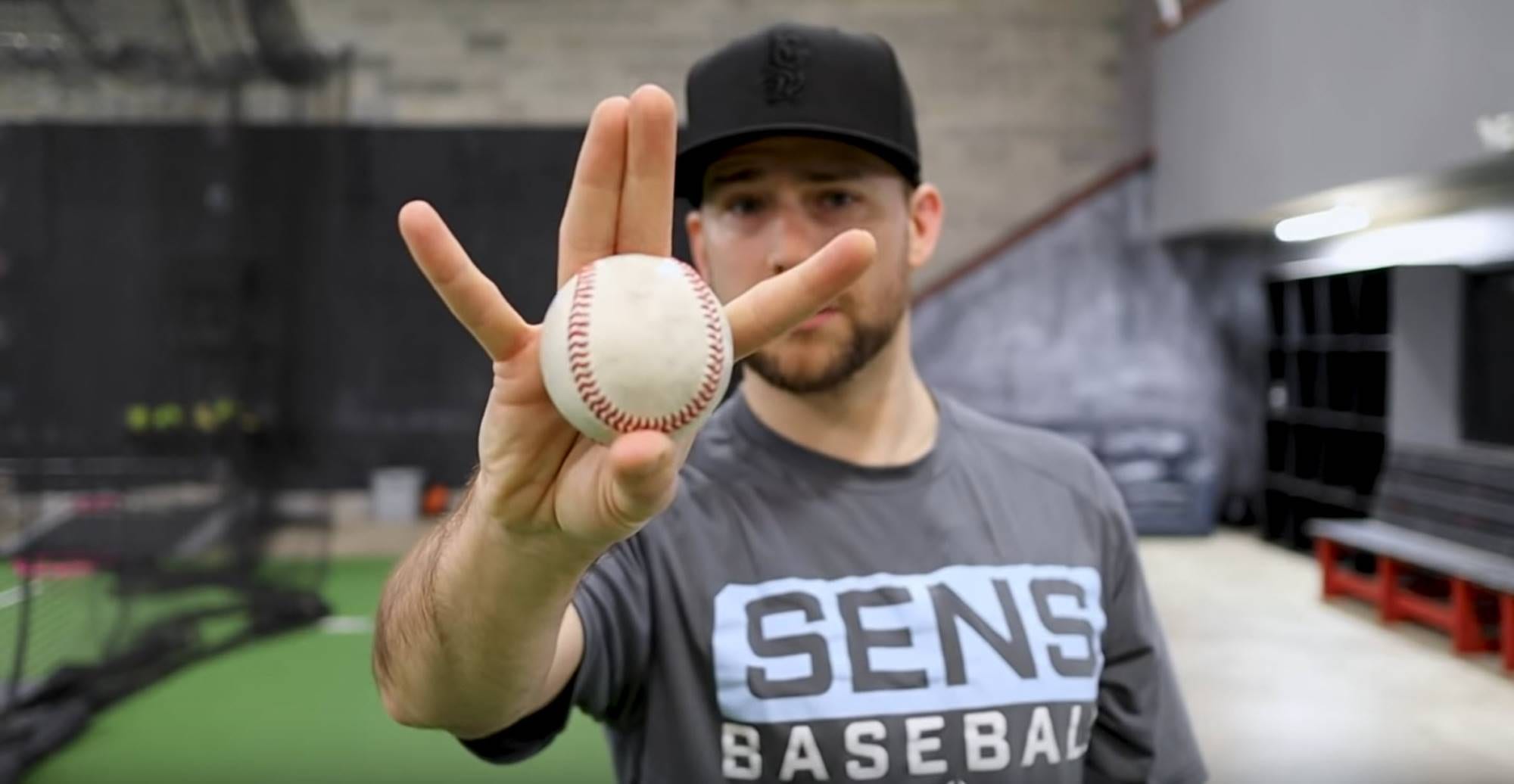
This is, again, just what it sounds like: holding onto things while your fist isn’t completely closed.  This type of strength is most important for pitchers and those who want to improve throwing velocity, because the force is applied to the ball from the tips of the fingers.  Having a strong fist isn’t going to help as much here, because closed fist exercises build more strength in the more proximal digits of the fingers.

Fingertips transmit power to the ball

Fingertips transmit power to the ball

Training Open Hand Strength

I keep talking about rock climbing, but it’s just a fact that those people have freaky strong fingers.  I see the parallel to throwing, and I try to adopt their training methods (within reason).  Loading the fingers should be a gradual process, as the lever arm is really lengthened, which further increases the stress on the forearm muscles.  Point being, don’t just jump into 10 minutes of 2-finger hangs from your door moulding – you’ll have tendinitis or a popped flexor in no time.

Strong Fingers.

Strong Fingers.

Use An Open Hand Grip…

On Hangs...

...On Hangs

When holding dumbbells or doing farmer's walks

...When holding dumbbells or doing farmer's walks

By pinch-holding the head of dumbbells

...By pinch-holding the head of dumbbells

When carrying weight plates

...When carrying weight plates

while squeezing the life out of a medicine ball

....While squeezing the life out of a medicine ball

Final Thoughts

As you probably realize, grip training is something that never has to get boring, as it can be varied a thousand different ways.  I just want people out there to start thinking about what their goals are, and how their training is preparing them for their sport.  In baseball, I think it’s clear that grip strength is huge.  Yet, an even more narrow focus (open vs. closed) should yield maximum carryover to the field.

There is more to talk about as far as forearm strength in hitting is concerned, which I will touch on in the upcoming weeks.

7 Responses to “Baseball Specificity of Open vs. Closed Hand Strength”

  • Fred Dimpfel:

    I am a big believer in grip strength and I specifically train my forearms every week through a variety of exercises. My goal is to crush a man’s hand when I go to shake it as well as rip as many phone books in half as I can at social gatherings. As arbitrary as my goals may be, I am very tuned in to grip training. I have worked with Dan and seen vast improvements in my grip strength by applying the methods he is talking about. But with all the success in the forearm muscle growth department, I question its applicability to the baseball swing. Several years ago, I partnered with my baseball coach and intensively studied the baseball swing and one of the concepts we settled on was that bat speed was generated by hip rotation and body torque. Another concept that we focused on was the grip of the baseball bat. We determined that a loose grip on the bat relaxed the muscles in the forearm and allowed the arms to move faster thus the bat will swing faster. Surely you have heard this concept before, relaxed muscles react and move faster than tense muscles. I challenge you to grip the bat as hard as you can and swing it, then grip the bat easily and take a rip. Which one feels faster? I guarantee the easier grip felt faster and we could measure a difference in bat speed too. I came across this article and although the study was applied to softball players, there was no correlation in increased grip strength with increased bat speed. With that aside, the point I want to make very clear is that there are benefits to increased grip strength although they may not pertain directly to bat speed. Strong dense forearms are beneficial to a hitter as opposed to a hitter with toothpicks connected to his elbows. The strong forearm hitter should be able to wield the bat with more control than the weakling and therefore better control will lead to more consistent contact with the baseball. And when I think about the great hitters during the steroid era of baseball, they obviously had monster upper bodies with big forearms to boot. Barry Bonds became a massive human being and I believe his increased arm strength allowed him to control his bat that was moving faster due to increased hip explosiveness. So do not use your massive forearms against you and squeeze the life out of the bat, instead use them naturally to grasp the bat with increased control.

    • Dan Blewett:

      That’s an excellent point, Fred. Yes, for a hitter the point of having a great grip is not to squeeze the life out of the bat. Rather, as I will discuss in a later post, additional power is generated through forearm ulnar deviation as the bat comes through the zone, and bat control is enhanced by the grip in general. Tense muscles don’t perform well, as you said.

  • Fred Dimpfel:

    Article hyperlink that did not copy over:
    http://www.iowaahperd.org/journal/j97s_baseball.html

    • Dan Blewett:

      That study, while it shows a correlation between softball players, I think is very limited. It’s not just increasing bat speed that we’re after, but applying force to the ball. Imagine if someone pitched you a bowling ball – if you could even manage to hit it forward, the collision of the ball and bat might be so great as to knock the bat out of your hands. Your grip would be the limiting factor at impact, because higher forces would suddenly be applied. Youth hitters sometimes appear to have their bats knocked backward by the ball at impact, because the shock of the ball has more of a braking effect than with stronger hitters.

  • Jon Hart:

    Increased grip strength yields increased bat speed and power, but only if the grip is loose until the point of contact. If the bat is not allowed to move backwards as it makes contact with the ball, ie strong closed grip strength, the trampoline effect is magnified, thus providing a more true sound, and as I like to call it, thwack. The simplicity of it is, strength is never a downfall.

    • Dan Blewett:

      Having a loose grip until impact is definitely necessary for maximum performance, but let me offer another reason to have a crushing grip: it allows more force to be applied to the bat with less effort. If your hands are weak, then you have to exert more of your maximal strength to simply holding onto the bat throughout your swing, and especially at impact. If your grip is incredible, then suddenly having relaxed forearm muscles becomes easy, as it takes relatively little effort to maintain control of the bat.

  • Jon Hart:

    I should elaborate on the “sound” I referred to, strong hitters bats make a different sound, because the bat is not allowed to stop and compresses more. Many good hitters will listen to the sound of their bat and know the difference.

Leave a Reply